
Guided setup verification
Requirement: REQ-PRODUCT-SETUP.
Automated coverage uses the shared engine, actual CLI subprocesses, JSDOM and a host-authorized Worker request surface. It checks unknown/no/yes decisions and catalog references; explicit market review; private notes absent from compiled public artifacts; preserved imported settings, content and facts; draft review reset; contradiction reporting; bounded schemas and input; private/non-overwriting CLI output, ignore rules, symlink rejection; detached plans; stale object URL invalidation; safe text/link rendering; asynchronous local import, edit/reset races; retained storage notes and saved report resume; and authorization/method/CSP boundaries. Local browser imports do not call a persistence endpoint.
Commands: npm run build, then node --test packages/notabenda/test/setup.test.mjs packages/notabenda-cf/test/setup.test.mjs.
Actual mobile/desktop Chromium and local CF runtime checks are recorded here when performed. No full platform/accessibility or regional legal review is implied.
Chromium verification, 18 October 2026: the real local screen rendered on desktop and a 390×844 viewport. Synthetic public facts, EU/EEA and California interests, and an optional-storage answer produced the expected review, separate config/private-report download links and catalog-linked recommendations. At mobile size, client and scroll widths matched (375 CSS px after the scrollbar). A browser check exposed inline download-button wrapping; the fixed layout uses separate full-width mobile actions. Screenshots: desktop, mobile, exports, recommendations.
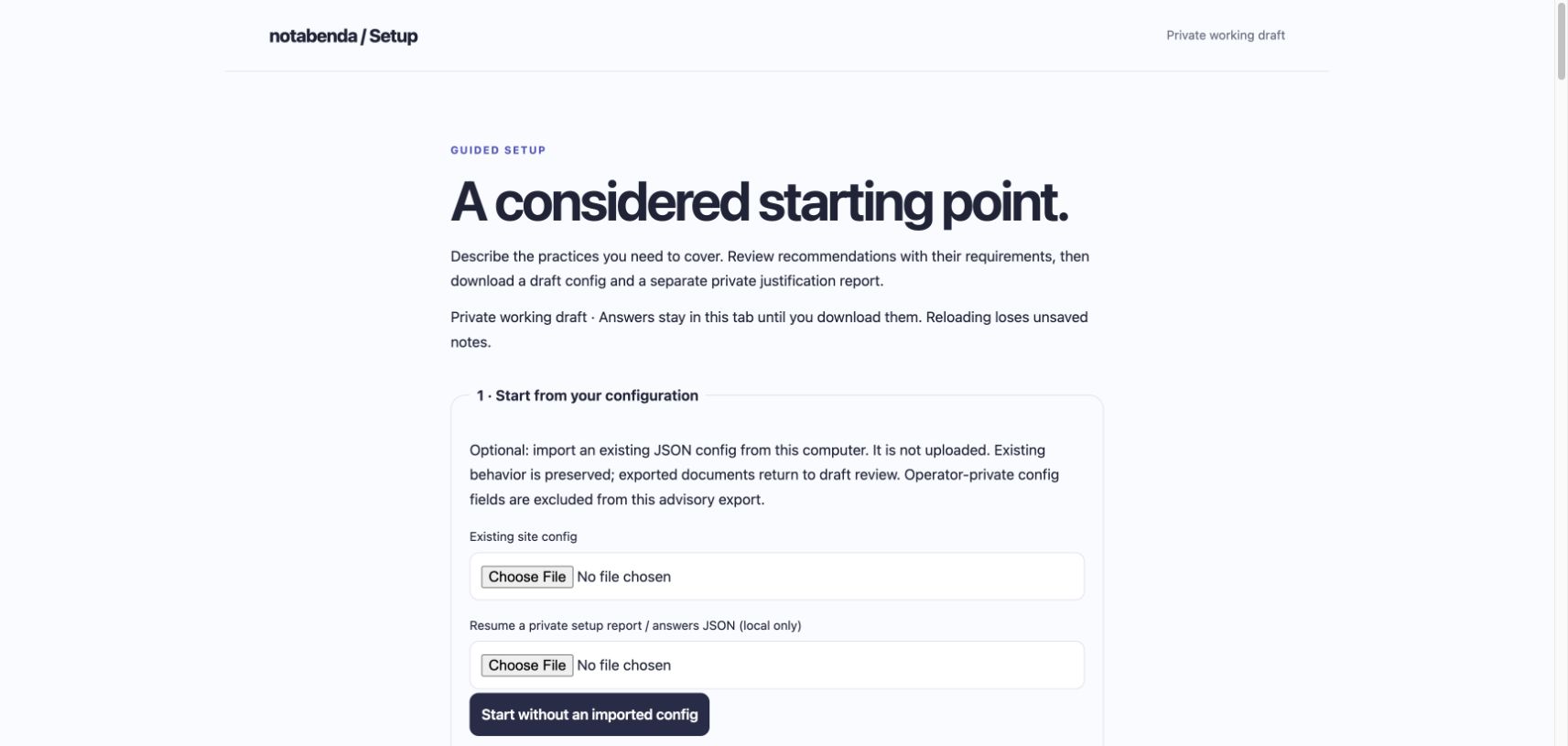
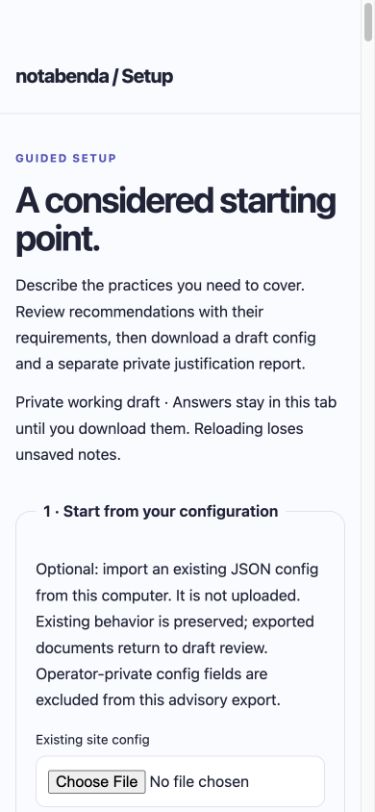
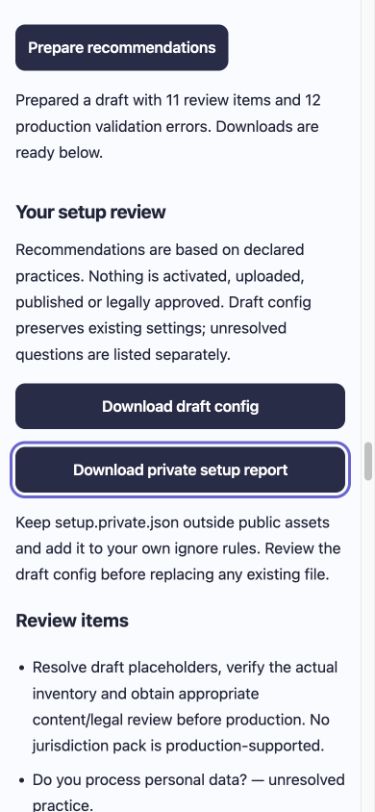
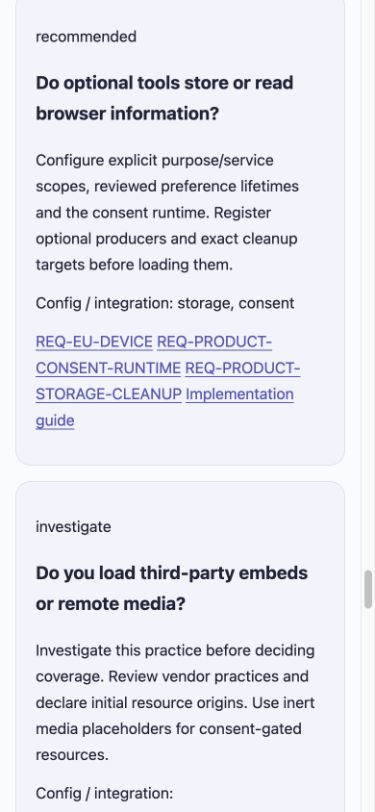
A direct browser download/readback attempt stalled in browser automation and was not counted as a verified download. Automated tests verify exported contents, private separation, CLI writes and report resume. The actual interactive CLI was driven through a terminal with fictional site facts, one coverage interest and all ten practice/justification pairs; both resulting JSON files were inspected successfully.
The actual local Workers runtime returned 401 without host authorization, private/no-store setup HTML with authorization, no connection permission in the setup CSP and 405 for POST. No questionnaire-answer storage endpoint was added. The project-wide check passed 187 package tests and 18 host tests, catalog validation, website build and a Worker deployment dry-run. Later presentation changes passed the 44 affected setup/storage/host tests. Nothing was committed, published or remotely deployed.
Setup composition refinement
The six section controls now have explicit accessible names and visible location markers. Jumping between stages focuses the section and brings its guide into view; preparing recommendations focuses the generated review. Imports are grouped into configuration and saved-answer panels. Review items use a native disclosure above a responsive recommendation grid. Private answers, local-only import, draft status, requirement links and stale-download invalidation are unchanged. Automated navigation coverage also checks assessment state, the visible review target and focus after generation.
Actual Chromium inspection on 18 October 2026: all six stages had equal document/client widths at both 320px and 390px viewport overrides (305px and 375px content widths after scrollbars). Step controls were 46px high; assessment inputs used 16px text. A fictional yes answer and private note survived a round trip through site facts. Preparing the review displayed two download links, a collapsed review-item disclosure and the expected recommendation; focus moved to the review heading. Desktop entry and practices, mobile practices and the generated review were visually inspected. Download file contents remain covered by automated tests; no new manual download readback is claimed.
The full project check passed 276 package tests and 37 site tests, catalog validation, site build and Worker dry run. Final focus refinements passed all 13 affected package/Worker setup tests and rebuilt the site. Desktop entry, desktop practices, mobile practices, mobile review.
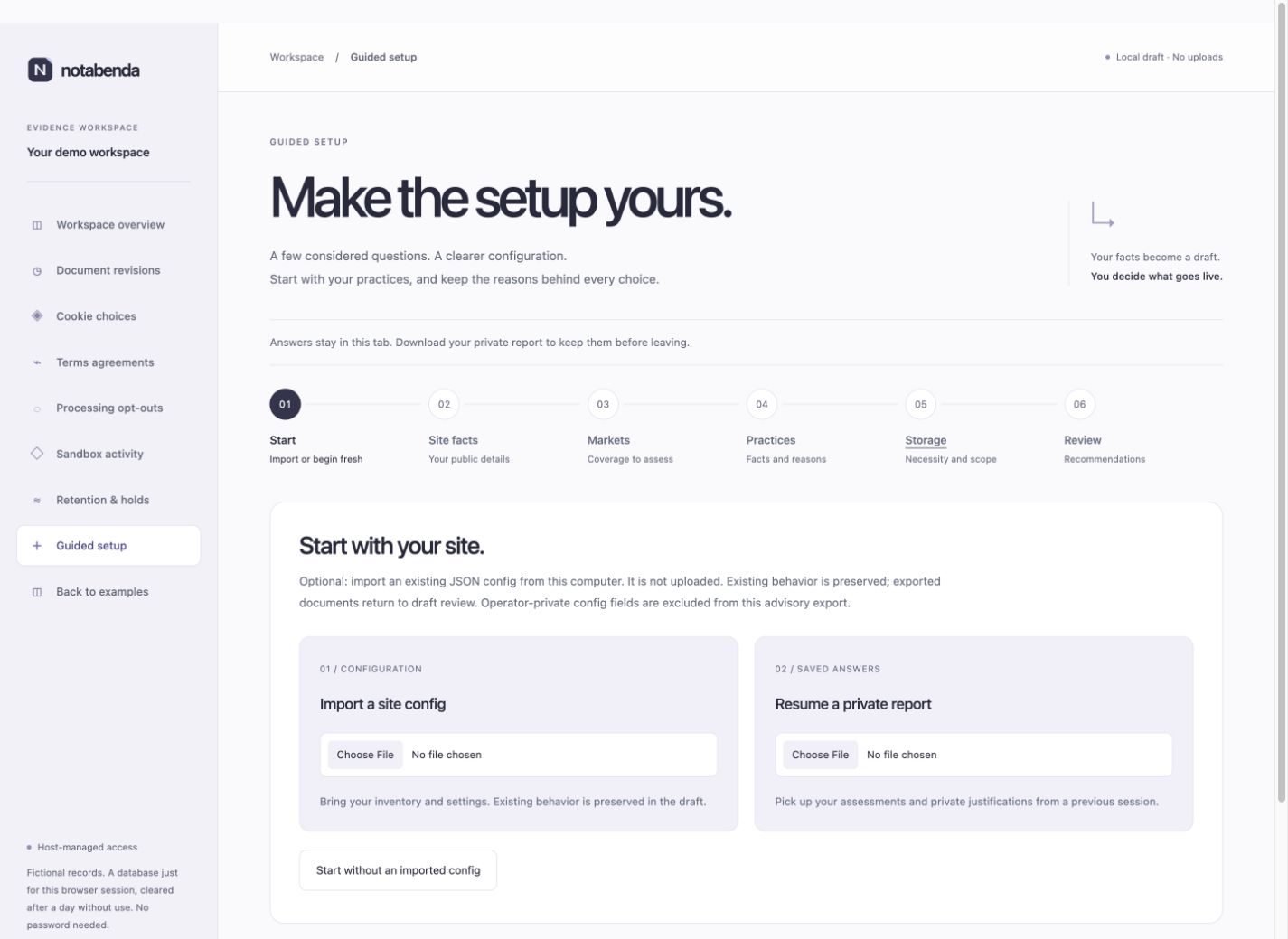
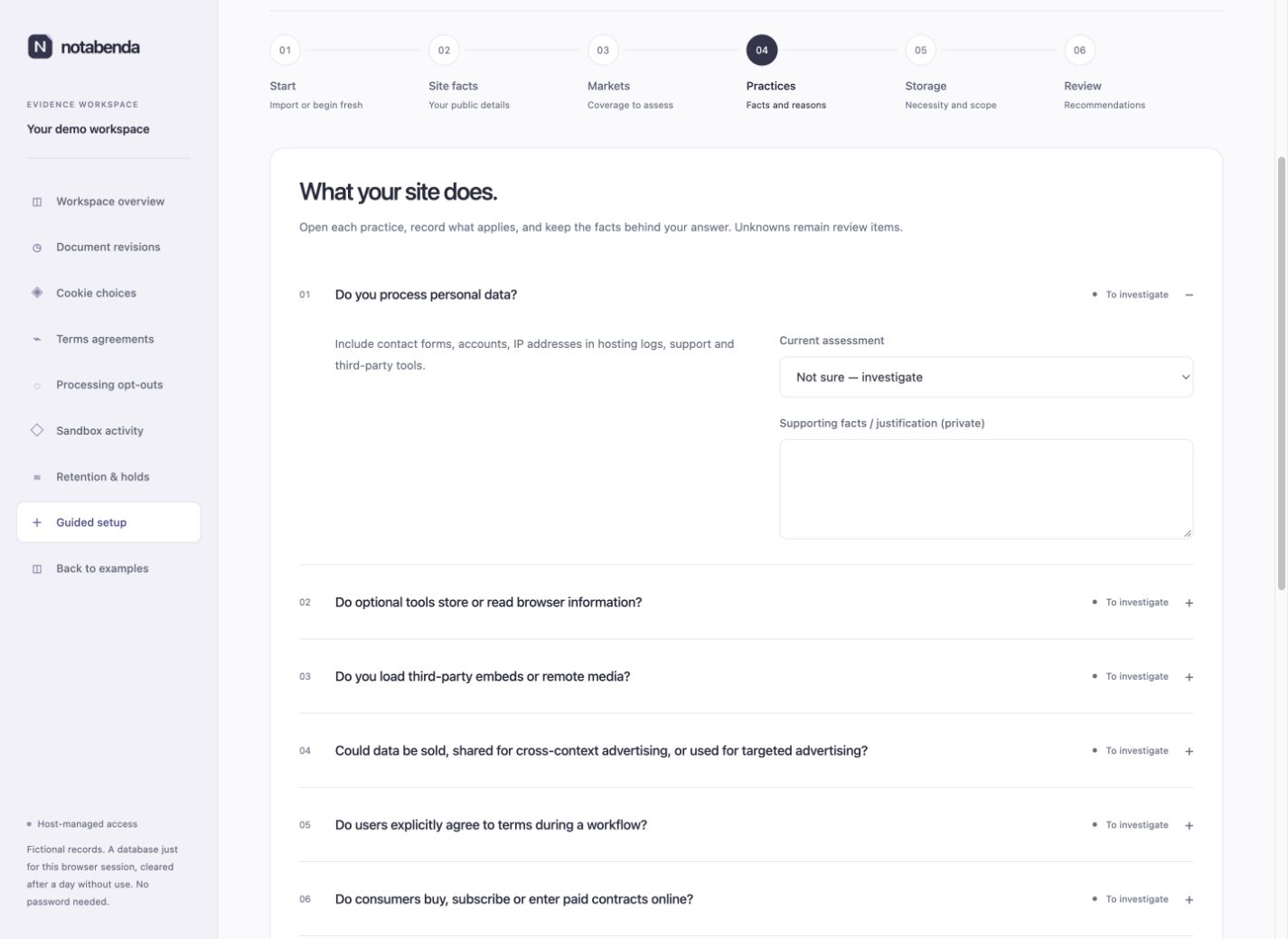
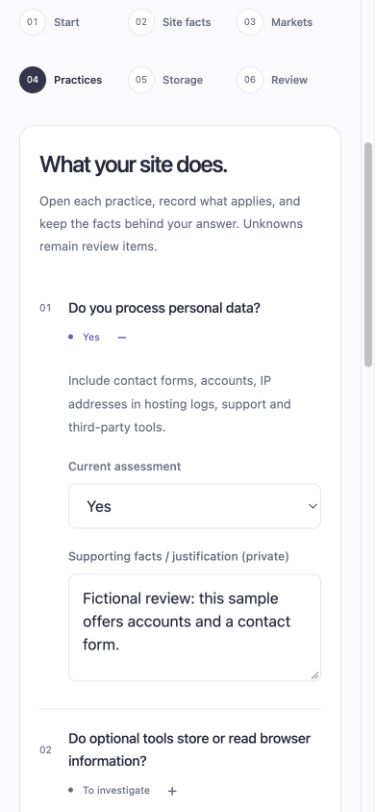
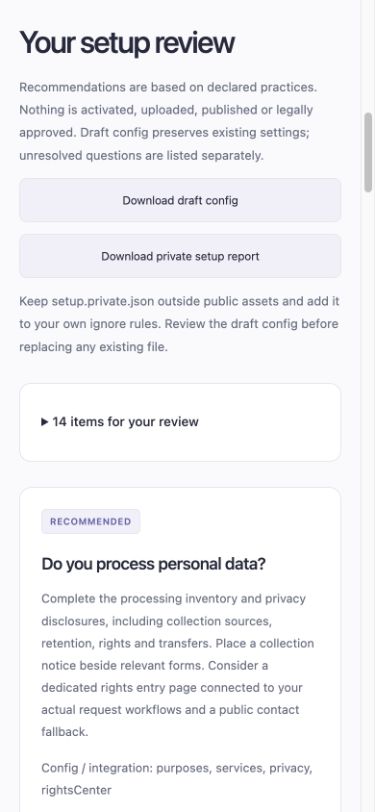
Operator clarity and correction
The guided form now identifies invalid public URLs/email/IDs inline, focuses the offending field and supports Enter to continue without prematurely preparing a review. Assessment/justification names include their question. Imported defaults remain visible beside override fields. Review shows actual diagnostic paths, messages and requirement links with additional fixes folded. See the UX review for current browser observations and limits.
Contract guidance, questionnaire revision 3
Four additional engine/CLI/admin tests cover distance and continuing-contract questions, Germany coverage interest, exact catalog and guide references, advisory host paths, unchanged public configuration, private-note exclusion, revision-1/2/3 report resume with unresolved new answers, regenerated recommendations and contradictory audience/payment declarations. The focused setup/scope suite passed all 30 tests. Selecting coverage or answering yes does not select a regional profile or start a provider.
Chromium inspection on 19 October 2026 confirmed all 15 practice questions in the real isolated demo admin. A yes answer to distance contracts generated the conditional form recommendation and a separate handoff-planning card with live catalog/guide links. Focus moved to the review heading; draft/private downloads remained separate and unknown questions stayed review items. This was a browser interaction check, not a legal applicability determination or downloaded-file readback.
Public processing-purpose authoring
The optional setup/purposes plan API and setup/purposes/ui editor now let a fresh config declare purposes before provider selection. The same guarded plans power interactive CLI add/edit/remove. Nine focused cases cover closed/bounded plain input and accessor rejection; detached config preservation; unresolved production-blocking placeholders; unchanged service links, consent scopes and restrictions; stale edit/removal and stable-ID guards; referenced removal refusal; native validity, cancel/confirmation and status focus; safe text and uncertain host failures; and a fresh setup/catalog flow with stale-note preservation. Both compatibility and compiled consent profiles reject a persisted grant after a material purpose edit. Packed-package checks exercise installed entry points and TypeScript declarations. These checks establish software behavior, not a reviewed legal basis or retention schedule.
Chromium acceptance on 19 October 2026 completed a fresh purpose → email-provider selection → recommendations flow without importing JSON. Blank basis/retention appeared at their exact purpose paths as publishing blockers; separate config/private-report actions remained available. The grouped editor was inspected on desktop and at a 390×844 viewport: document/client widths matched at 375px after the scrollbar, input heights were 50px, and native selects were 47px. The viewport override was reset. A real npx --offline --no-install notabenda wizard terminal run also started without an imported config, declared a purpose, selected an email provider and wrote both JSON outputs. Inspection confirmed purpose-source pins, private-note separation, unresolved placeholders and no added consent runtime. Browser download readback remains unverified.
The purpose-authoring stylesheet is confined to setup selectors. Its addition leaves the generated consent-only CSS byte-identical to the preceding published milestone; compiled consent JS/CSS remain 12.18/2.21 KiB gzip. Full component styling is measured separately in browser delivery.
Direct assessment grid
Practice assessment now exposes all 15 questions in four topic groups. Full questions, help and native Yes / No / Not sure choices are visible; only optional private notes use a disclosure. Imported notes open initially. A two-column container-query layout becomes one column when two readable cards do not fit. It uses normal DOM order, not masonry. Counts distinguish yes/no assessments, unresolved choices and supporting notes.
Automated coverage checks directly available choices, unique radio names across two mounted wizards, unknown semantics, independent contract questions, retained imported notes, private/public separation, report generation and stale-export invalidation. Radio Enter cannot navigate or submit; earlier questionnaire versions retain the same migration behavior. Catalog re-review and its private history remain covered separately. Obsolete accordion CSS was removed from package and admin styles.
Actual Chrome checks: desktop two-column layout, direct answering, native arrow navigation and Enter remaining in Practices. At 390px, all three labels measured 44px high; at 320px, wrapped choices were about 52px high. Both inspected widths had equal scroll/client widths. Private notes could be opened and edited, updating the note count independently of the assessment. These are specific browser states; actual 200% zoom, screen-reader, WebKit, physical devices and forced-color rendering remain open. Forced-color selection/focus rules are present, not claimed device-certified.
The full check passed 522 package tests and 62 site tests, catalog validation, site generation and Worker dry run. Screenshots: desktop grid, mobile grid. See catalog re-review verification for the adjacent workflow and its remaining download-readback limit.
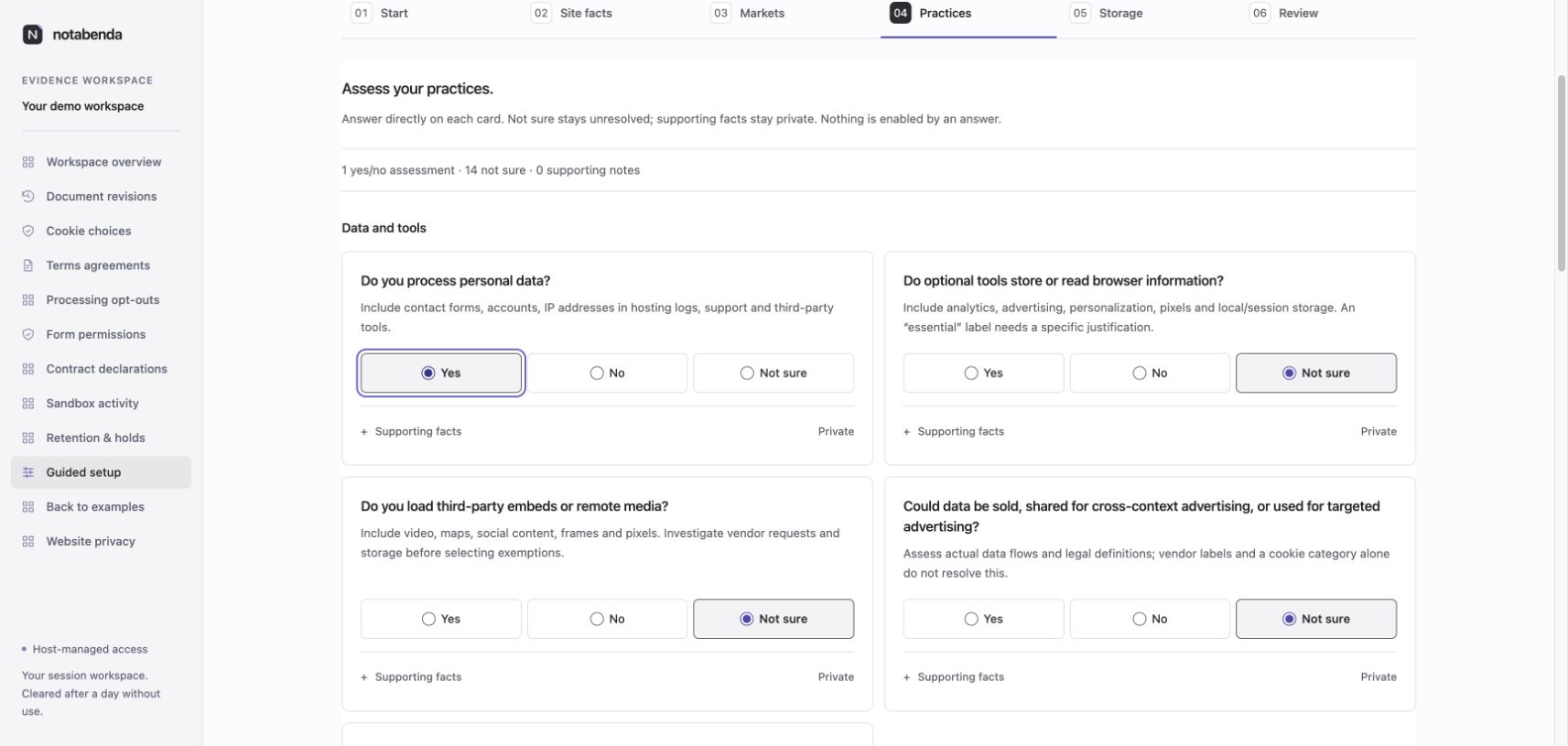
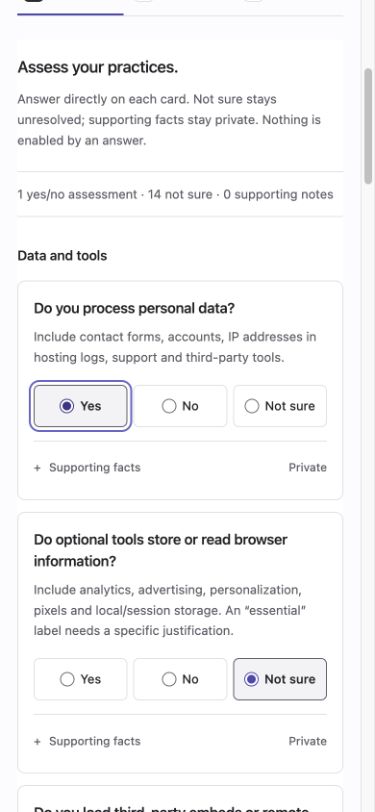
The standalone mount was also visually inspected with only the package stylesheet, outside the admin shell. It showed two readable columns on desktop, 15 native groups and 44px labels, and one contained column at 320px (305px scroll/client width). This confirms the grid is part of the reusable component, rather than only the website host.